
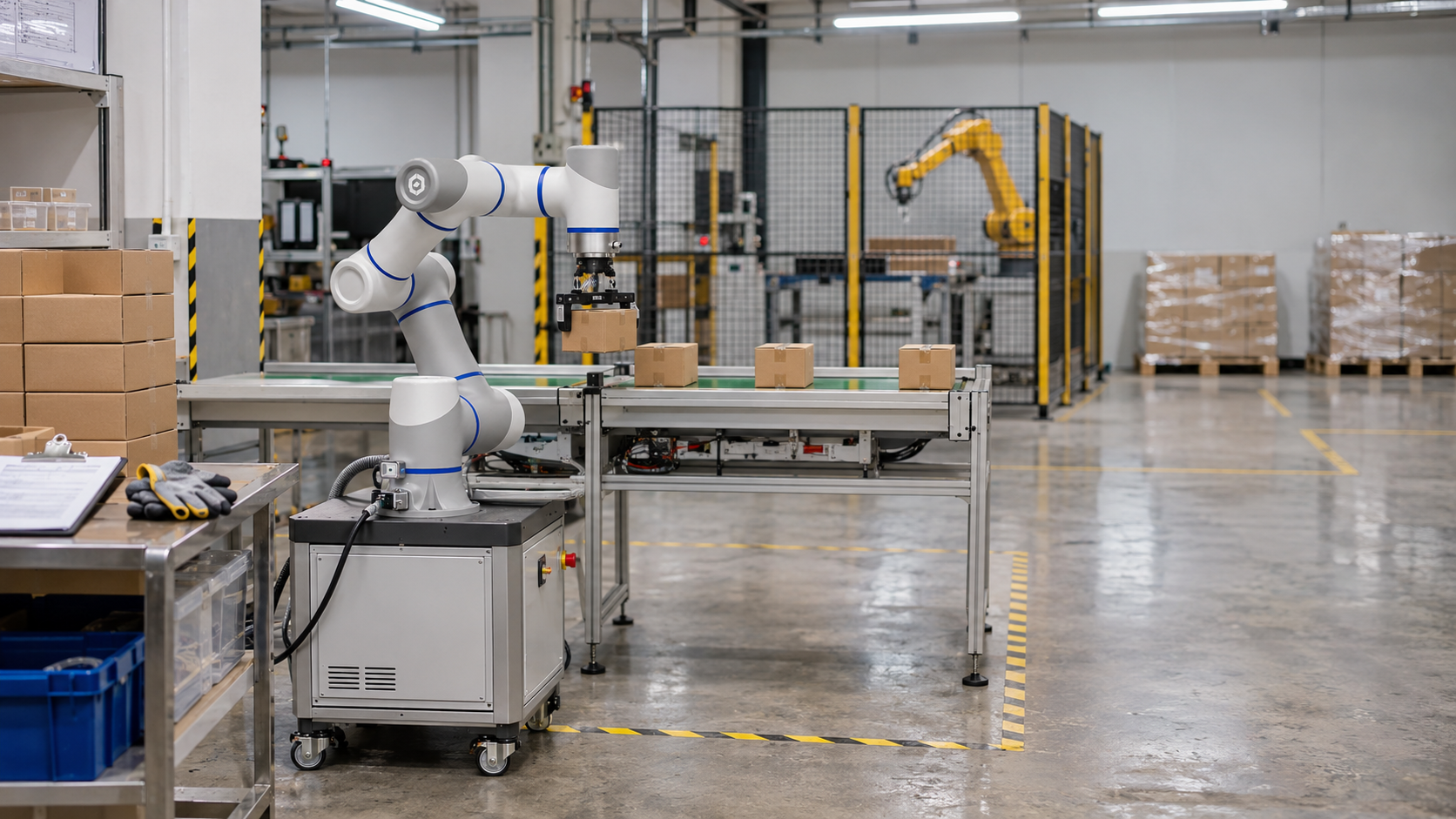
Collaborative robots, or cobots, and traditional industrial robots can both do useful work in a factory. They are built for different situations, and choosing the wrong type is a common and costly mistake. The right choice depends on your task, your space, your people and your plans for growth, not on which type sounds more modern.
This guide explains the main differences in plain terms and gives you a simple way to decide.
What is the difference?
A traditional industrial robot is a strong, fast machine built for repeated work at high speed. It usually works inside a guarded cell with fences, light curtains or other safety devices, so people stay out of its path while it moves.
A collaborative robot is designed to work closer to people. It usually has features such as force limiting or sensing that help it stop when it meets resistance. This can allow it to share a workspace with a person, but only after a proper risk assessment of the whole application, including the tool and the objects it carries.
The word “collaborative” describes the design of the robot arm. It does not make every application safe by itself. A sharp tool or a heavy object can still be dangerous, and the safety of the complete setup is what counts.
Where each type tends to fit
Industrial robots
- High-volume, repetitive work where speed matters
- Heavy parts or long reach
- Fixed processes that change rarely
- Spaces where a guarded cell is acceptable
Collaborative robots
- Mixed or changing tasks, and shorter production runs
- Tasks next to people, such as loading, packing or simple assembly
- Smaller spaces where a full fenced cell is hard to fit
- Teams starting automation for the first time
- Teaching and training, where students work close to the robot
Six questions that help you decide
- How fast must the task be? If cycle time is critical, ask for a test on your own parts before you decide.
- How heavy are the objects? Compare the payload with the weight of the object plus the gripper or tool.
- Will people work next to the robot? If yes, plan the risk assessment first and involve your safety team early.
- How often will the task change? If it changes often, ease of programming and moving the robot will matter more.
- How much space do you have? A fenced cell needs room, including the fence and access doors.
- Who will program and maintain it? Match the robot to the skills of the people who will use it every day.
Common misunderstandings
- “A cobot needs no safety work.” It still needs a risk assessment of the whole application.
- “An industrial robot is always better for production.” Not if your task changes often or your space is small.
- “A cobot is always slower.” It can be, depending on how it is set up for safety around people. Test the task you care about.
- “The robot is the whole project.” The gripper, fixtures, software, safety setup and training are a large part of the work.
Do not forget the rest of the cell
The arm is only one part of the application. Think about the tool at its end, the way parts arrive and leave, the mounting, the controller and software, and how the robot connects to your machines. Ask your supplier to include all of these in one written plan.
Test before you commit
If you are not sure which type suits you, try it. A pilot on one task, a short rental, or a service plan lets you see real results in your own space before you make a bigger decision. Agree in advance what success looks like, so the test gives you a clear answer.
Where to go from here
Start with the task and the space, then choose the type of robot. Write down the task, the weight of the objects, the speed you need, who will work nearby and who will run the robot. With these answers, the choice between a cobot and an industrial robot is usually much clearer.
If you would like a second opinion, tell us about your task and your site. We will help you shortlist options and explain them, in writing, before you decide anything.