
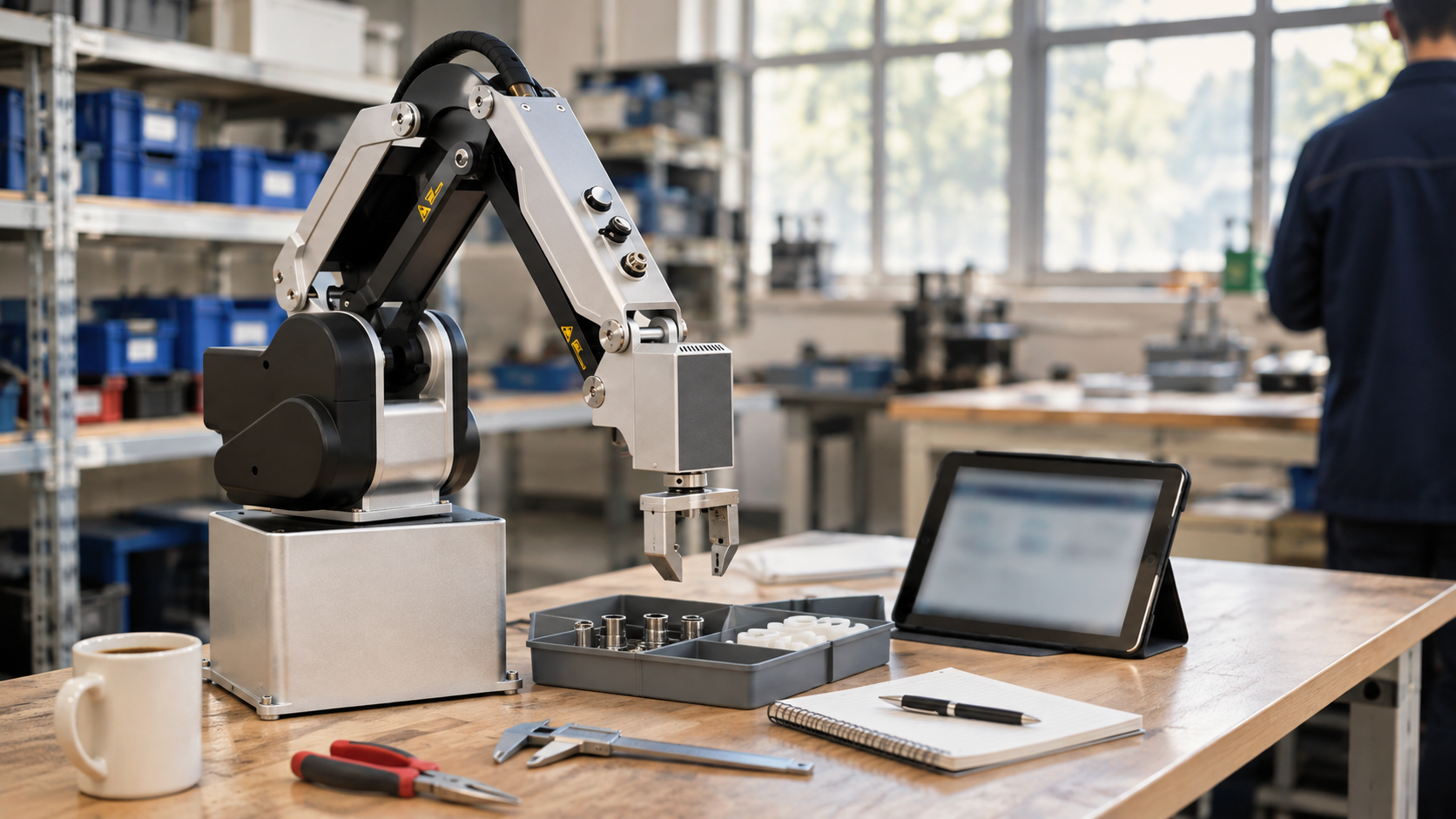
The best first robot is the one that fits a clear task in your own space, not the one with the longest spec sheet. Most disappointing robot projects start with the robot and look for a job later. The good ones start with the job.
This guide gives you five questions to answer before you talk to any supplier, the mistakes to avoid, a simple checklist, and a way to start small so your first project teaches you something before it costs you a lot.
Why the first choice matters
Your first robot sets the tone for everything that follows. If it solves a real problem, your team gains confidence and the next project is easier to approve. If it ends up in a corner because nobody knew how to use it, the whole idea of automation gets a bad name inside your company.
A good first choice is not about picking the most advanced technology. It is about picking a task that is clear, repeatable and worth doing, and then matching a robot to it.
Five questions to answer first
1. What exact task should the robot do?
Write the task as one sentence with a start and an end, for example “move bins from the packing table to the shelf” or “greet visitors and answer five common questions”. If you cannot write the sentence, you are not ready to choose a robot yet.
Useful details to add:
- How often the task happens and how long it takes today
- What the robot must handle, such as size, weight and shape of objects
- What “done well” looks like, so you can judge the result later
2. Where will it work?
Floor type, door widths, lighting, noise, temperature, people walking by, and whether the space is indoors or outdoors all decide what is possible. A robot that works well in a lab can struggle in a busy corridor.
Walk the route the robot will take, at the busiest time of day, and take notes. Narrow passages, thresholds, glass walls and crowded corners are the things that surprise people.
3. Who will run it every day?
Name the person. A robot needs an owner who can start it, check it and call for help. Think about their skills and how much time they have. A robot that needs ten minutes of attention a day is very different from one that needs two hours.
4. What does it need to connect to?
Some robots work on their own. Others need your network, your software, your tools or your safety systems. Ask early what the robot needs from you, and who on your side can provide it. This is also the right moment to involve your IT and safety teams, not after the purchase.
5. What happens after the delivery?
Setup, training, support, spare parts and updates are part of the project. Ask who handles each one, and ask for the answers in writing. A robot with no clear support is a risk, however good the hardware looks.
If you can answer all five in a short paragraph, you are ready to compare robots.
Five mistakes to avoid
- Choosing by the spec sheet. Payload, speed and reach matter only for your task. Compare robots on the job, not on the biggest number.
- Skipping the site visit. Photos and floor plans miss narrow doors, uneven floors and busy hours. Have the space looked at before you decide.
- Forgetting the people. Staff who are not trained, or not told why the robot is there, will work around it. Plan training and a short briefing for everyone who shares the space.
- Counting only the purchase price. Setup, accessories, training, support and spare parts all belong in the budget. Ask for one written quote that lists them.
- Aiming too big. A first project with ten robots and five goals is hard to finish. One robot with one clear goal is easier to learn from.
A short checklist before you contact a supplier
Collect these in one page and you will get better answers, faster:
- The task, written as one sentence
- The place, with a few photos and the key measurements
- The person who will run the robot
- The systems or tools it must work with
- Your timing and your budget range
- How you would like to pay: buy, rent or a service plan
Start small, learn fast
You do not have to buy a robot to find out whether it works for you. Many teams begin with a smaller step:
- A pilot on one task. Run one robot on one task for a fixed time and agree in advance what success looks like.
- Rental. A short rental suits an event, a course or a test on your own site.
- A service plan. Pay for the robot, its setup and support together instead of buying it.
- A phased purchase. Start with one robot and add more once the first one has proved itself.
Each option has different terms, so ask for them in writing. What you learn from a first project, such as which tasks suit the robot and what your team needs, is worth more than the first robot itself.
Where to go from here
Start with the task, not the robot. Write it down, visit the space, name the person who will run it, and choose a small first step. Then compare robots against that plan.
If you want a second pair of eyes, tell us your task and your space. We will help you shortlist robots and explain the options, in writing, before you decide anything.