
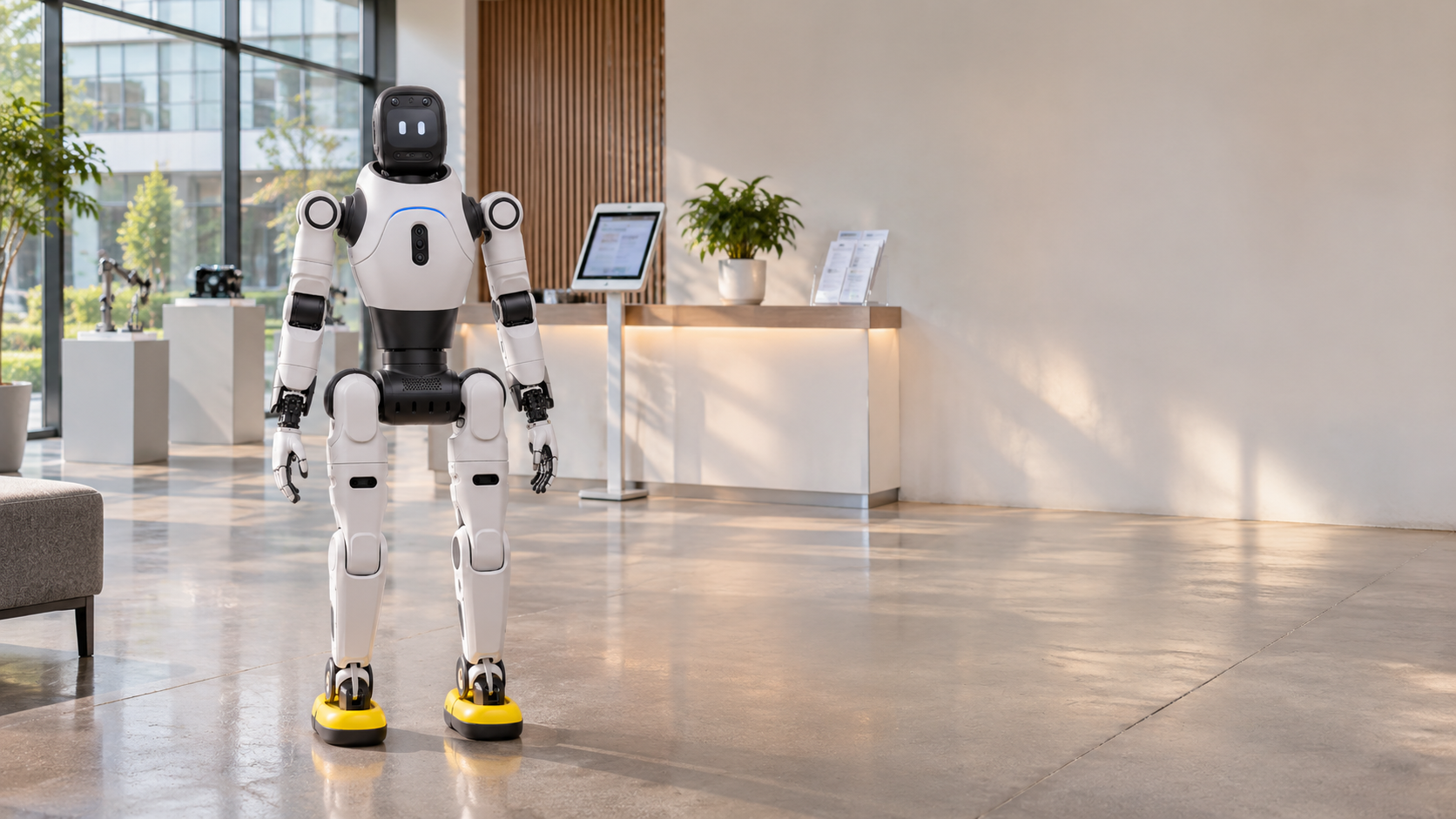
Humanoid robots get a lot of attention, and it is easy to see why. They have a head, arms and a body shaped like ours, so they look like they could do anything a person can. Today the reality is more specific. Humanoid robots are already useful for some jobs and not yet a good fit for many others. Knowing the difference saves you from buying a robot for a job it cannot do.
This guide explains what humanoid robots are, where they work well today, where they struggle, and how to decide whether one belongs in your plans.
What is a humanoid robot?
A humanoid robot has a body plan similar to a person: a torso, a head, two arms, and either two legs or a wheeled base. The shape is not the goal in itself. It is a way to let a robot work in spaces made for people, such as rooms with stairs, doors, counters and shelves.
Humanoids come in a few common forms:
- Walking humanoids move on two legs. They are good at showing movement, interacting with visitors and testing new control methods.
- Wheeled humanoids combine two arms with a wheeled base. They are often chosen for work at tables, shelves and workstations, because wheels give stable, efficient movement on flat floors.
- Upper-body humanoids have a head, torso and arms but do not move around. They suit reception, companionship and research on interaction.
Where humanoid robots work well today
Welcome and information
A humanoid can greet visitors, answer simple questions and guide people through a showroom, museum or lobby. The human-like shape helps people feel comfortable talking to it, and a display or voice can add expressions and information.
Events and demonstrations
Performances, product launches and trade shows are a natural fit. Here the robot’s movement is part of the experience, and the environment can be prepared in advance.
Research and education
Universities and labs use humanoids to study movement, control, perception and human-robot interaction. Many platforms allow secondary development, so teams can write their own software or add sensors.
Data collection
Humanoids can be teleoperated by a person to record how tasks are done. This data helps teams train and test robot skills for the future.
Manipulation work at stations
Wheeled humanoids with two force-controlled arms are being explored for tasks such as handling, assembly and material movement. Such use needs a careful look at the task, the payload and the safety setup.
Where humanoids still struggle
- Battery life. Many humanoids run for a few hours at a time. Plan for charging or battery swaps.
- Payload. Arms are usually built for light objects. Check the rating for your object and the tool together.
- Speed. Typical working speeds are slower than a person walking quickly. Fast pick-and-place is often better done by a dedicated arm.
- Uneven or crowded places. Stairs, outdoor ground and busy crowds are difficult. Always test in your own space.
- Complex tasks without preparation. Demonstrations can look smooth because they are prepared. A new task usually needs setup, programming and testing.
- Cost and support. Humanoids are advanced machines. Ask about setup, training, updates and repair before you decide.
When a humanoid is the right choice, and when it is not
Consider a humanoid when people will interact with it, when you need a robot for a research or teaching platform, or when the task takes place in a space designed for people and a dedicated machine would be hard to fit.
Consider something else when the task is simple and repeated, such as picking parts at a fixed point. A robotic arm on a stand is usually simpler, faster and more affordable for that.
Five questions to ask before you choose
- What exactly should it do? Write the task in one sentence.
- Who will meet or work with it? Visitors, students, staff or researchers need different features.
- Where will it work? Check floors, doors, lighting, noise and space.
- What can it carry and how long can it run? Compare with your real objects and shifts.
- Who supports it? Ask about setup, training, spare parts and updates in writing.
Try before you commit
Because the field is moving fast, a short rental or a pilot on one task is a sensible first step. You will see what the robot can do in your own space and what your team needs, before a bigger decision.
Where to go from here
Humanoid robots are an exciting tool, and the best results come from a clear, modest first task. Define the job, visit the space, and start small. Then decide whether a humanoid, a robotic arm or another type of robot fits best.
If you would like help comparing options, tell us about your task and your site. We will help you shortlist robots and explain the options, in writing, before you decide anything.